Palette Knife Techniques for Beginners: A Guide to Textured Creative Flow
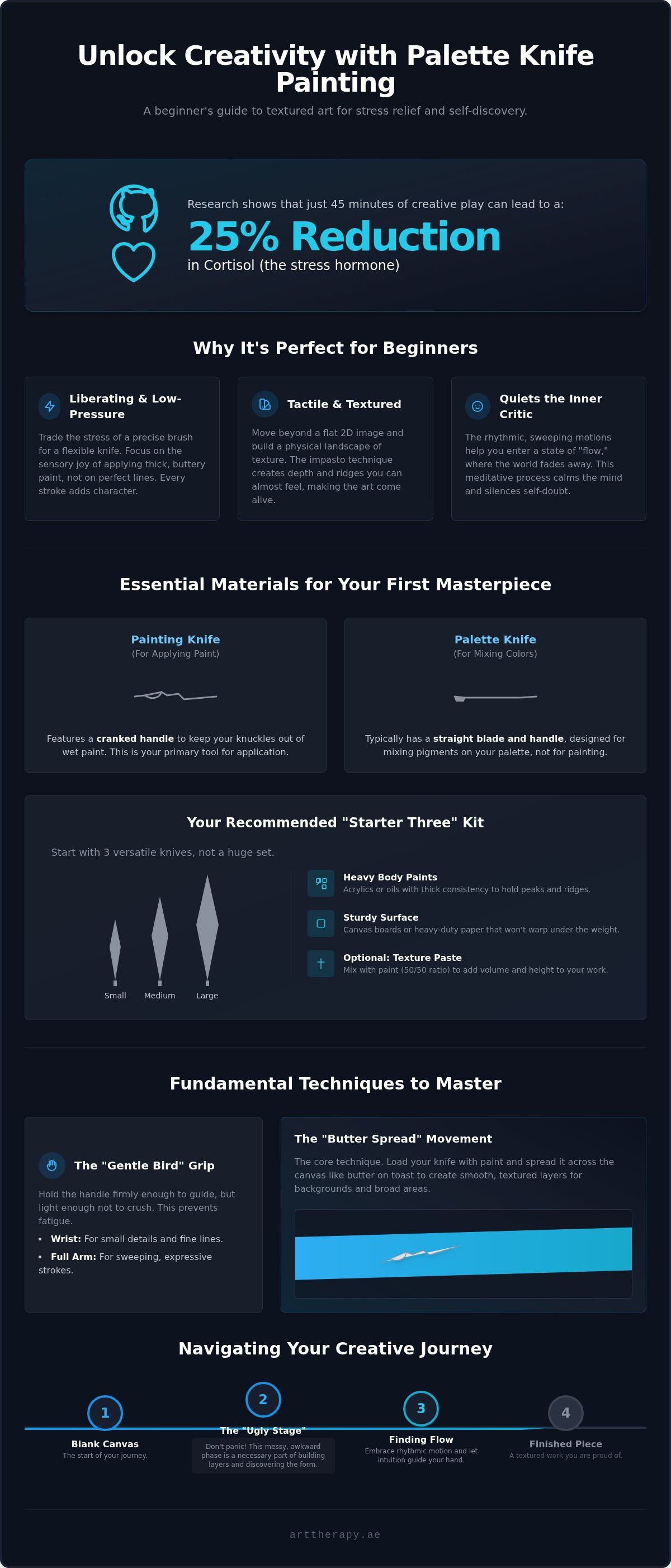
Research from early 2025 suggests that just 45 minutes of creative play can lead to a 25% reduction in cortisol levels. In the vibrant, fast-paced heart of Dubai, finding a sanctuary for such stillness is essential for our inner balance and mental well-being. You might feel a quiet longing to create, yet find yourself held back by the fear of wasting materials or the heavy weight of feeling "not creative enough." It's common to feel overwhelmed by technical rules, but palette knife techniques for beginners offer a different path, one that prioritizes the sensory joy of the process over the pressure of a perfect result.
We understand that the transition from a blank canvas to a finished piece can feel daunting when you're navigating it alone. This guide promises to unlock the liberating world of impasto and thick, buttery textures, helping you quiet your inner critic through simple, rhythmic movements. You'll learn to embrace the tactile nature of the palette knife as a bridge to emotional clarity and stress relief. We'll walk through the basic language of the tool and how to build a textured piece you're truly proud of, preparing you for a journey of self-discovery that feels like a warm, supportive conversation.
Table of Contents
What is Palette Knife Painting and Why is it Perfect for Beginners?
Imagine a tool that removes the pressure of precision. A palette knife isn't just a utility; it's a bridge to a more liberated form of expression. What is a palette knife? At its core, it's a flexible blade of metal or plastic that allows you to apply paint in thick, buttery layers. Instead of the delicate, often stressful "pointy brush" approach, you manipulate paint much like you would spread butter on toast. This shift is profound. It invites you to stop worrying about fine lines and start focusing on the sensory joy of the medium. In our serene studio on Sheikh Zayed Road, we see how this simple change helps visitors shed their defenses and embrace the creative journey.
For many, the transition to 3D expressive surfaces is what makes palette knife techniques for beginners so rewarding. Traditional painting often feels like a struggle to replicate a 2D reality. With a knife, you're building a physical landscape. The low-stakes entry point is real. You can't really make a "mistake" when every stroke adds character and depth. It's a dialogue between you and the paint. This tactile experience often leads to a sense of "flow," where the world outside the canvas fades away, replaced by the soothing rhythm of the blade.
The Anatomy of the Grip: Holding Your Tool for Success
Mastering palette knife techniques for beginners starts with how you physically connect with the tool. Think of the "Gentle Bird" grip. Hold the handle with enough firmness to guide it, but with the lightness you'd use to hold a small bird you don't want to crush. Most of the magic happens in the wrist for small details, while your entire arm provides the sweeping, expressive strokes for larger areas. Finding this balance helps prevent fatigue and keeps your movements rhythmic. It’s about letting the tool become an extension of your own hand, translating internal states into external forms with ease.
Palette Knife vs. Painting Knife: Knowing the Difference
It helps to know exactly what you're holding. A true palette knife is usually straight and used for mixing colors on your board. For actual painting, you want a "painting knife." These have a cranked handle, a clever bend that keeps your knuckles out of the wet paint as you work. For those starting their journey, a diamond or teardrop-shaped blade is the perfect all-rounder. It offers a sharp point for fine details and a broad base for those satisfying, smooth backgrounds. Choosing the right tool from the start ensures your experience remains a supportive journey of discovery rather than a technical struggle.
Essential Materials for Your First Textured Masterpiece
Beginning your creative journey doesn't require an exhaustive list of expensive supplies. Instead of the overwhelming sets of ten or more knives often seen in commercial stores, we recommend focusing on the "Starter Three." A small, medium, and large diamond-shaped knife will provide all the versatility you need to explore palette knife techniques for beginners without the clutter. These shapes are specifically designed to hold paint securely while offering the flexibility needed for both broad strokes and delicate accents. Having just these three tools allows you to focus on the feel of the metal against the surface rather than deciding which tool to pick up next.
Your choice of surface is equally vital for supporting the weight of your expression. Because you'll be working with thick layers, canvas boards or heavy-duty mixed media paper are much better than thin paper, which can warp under the moisture and weight. For the paint itself, look for "heavy body" acrylics or oils. These formulations have the structural integrity to hold the peaks and ridges characteristic of the impasto technique, ensuring your textures remain as vivid and tactile when dry as they were when first applied. This physical presence of the paint is what transforms a flat image into a living, breathing piece of art.
The Role of Texture Pastes
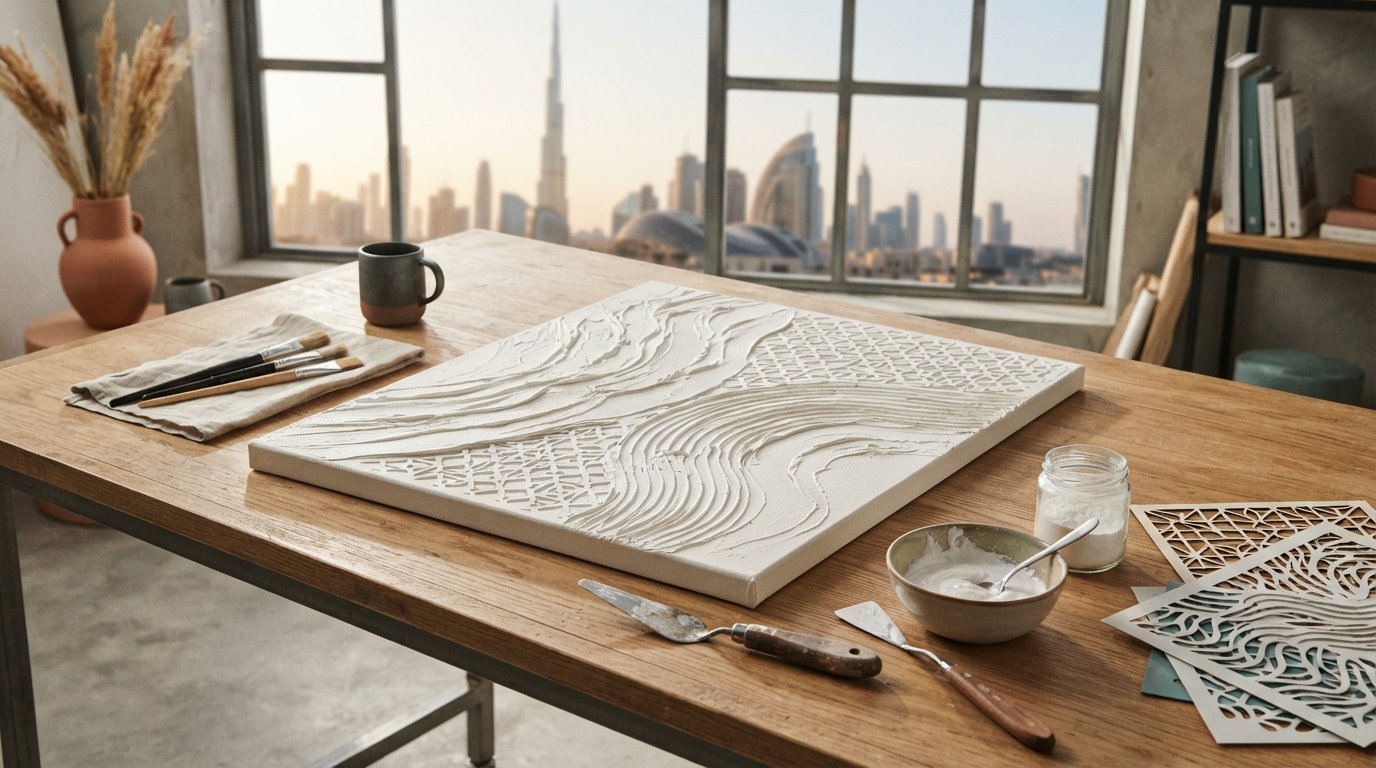
Modeling paste is a wonderful companion for those who want to explore height and depth. This thick, white medium can be mixed with your paint to stretch your pigments further or used alone to create a 3D foundation before any color is added. For beginners, a mixing ratio of roughly 50/50 is a safe starting point to ensure the paint remains vibrant while avoiding the cracking that can occur if the layers are too brittle. If you're curious about how these materials feel in a guided environment, our 3D Texture Art Workshop offers a protected space to experiment with these ratios under gentle guidance.
Setting Up Your Sanctuary: A Clean Workspace
Creating a sense of peace starts with your physical environment. A flat palette, made of glass or tear-off paper, is far superior to a traditional well-palette for this style of work. It provides the space needed to mix colors and "load" your knife evenly. Managing wet-on-wet layers is often the biggest challenge for those learning palette knife techniques for beginners; the secret lies in the "one-wipe" rule. Always keep a cloth or paper towel nearby to wipe your blade clean between every single stroke. This simple habit keeps your colors pure and prevents your beautiful textures from turning into unintentional mud, allowing your creative flow to remain uninterrupted.
5 Fundamental Palette Knife Techniques to Master
Mastering palette knife techniques for beginners is about finding a rhythm that feels natural to your own hand. Before the blade even touches the canvas, the way you load the paint sets the intention for the stroke. A "back-load" involves scooping a generous amount of paint onto the underside of the blade, which is ideal for broad, sweeping applications. In contrast, a "tip-load" picks up a small bead of paint on the very point, perfect for delicate highlights or sharp accents. While professional artists use dozens of variations, including these 16 palette knife techniques, focusing on five core movements prevents the overwhelm that often stalls creativity.
The Butter Spread: Use the flat of the blade to lay down smooth, wide areas of color for sky or water.
The Scrape (Sgraffito): Scratch through wet paint to reveal the layers or canvas beneath, adding fine details or texture.
The Dab and Lift: Press the blade into the paint and pull it straight up to create organic, jagged textures like foliage or stone.
The Thin Line: Turn the knife on its side and use the edge to "stamp" or draw thin, sharp lines for branches and horizons.
The Multi-Color Load: Scoop two or three colors onto the blade at once without mixing them to create instant marbling and harmony.
These movements are not just technical exercises. They are a form of sensory play that helps lower defenses and encourages a state of mindfulness. By focusing on the physical sensation of the paint resisting or yielding to the blade, you move away from the "clinical" pressure of art and into a collaborative journey of self-discovery.
Mastering the 'Butter Spread'
The secret to a successful butter spread lies in the angle of your blade. If you hold the knife too vertically, you'll end up "digging" into your previous layers and creating a muddy mess. Instead, keep the blade nearly parallel to the canvas, allowing the paint to glide across the surface. This technique is perfect for creating seamless gradients. By applying a light, rhythmic pressure, you can blend two colors together in a single stroke, mimicking the soft transition of a Dubai sunset over the Arabian Gulf.
The Magic of Sgraffito (Scraping)
Sgraffito is a liberating technique that allows you to "erase" or add detail with a single motion. It works best when the underlying layer is slightly firmer or a different color than the top layer. Use the tip of the knife to sign your name or define the delicate veins of a leaf. If a particular stroke doesn't feel right, you can simply scrape it away and start again. This ability to correct mistakes easily is why palette knife techniques for beginners are so forgiving, reinforcing the idea that the creative process is more important than the final result.
Navigating the 'Ugly Stage' and Finding Your Creative Flow
Every creative journey encounters a middle ground where the vision in your mind doesn't yet match the canvas in front of you. This is what many artists call the 'Ugly Stage.' Far from being a sign of failure, this phase is a vital marker of progress. In the context of palette knife techniques for beginners, the 'ugly' often represents the necessary structural layers that will eventually support your final highlights. It's a time for patience and trust, allowing the thick, unrefined textures to settle before you attempt to refine them. Embracing this messiness is the first step toward true creative freedom.
The true magic of this process lies in the 'Flow State.' As you move the blade across the surface, the rhythmic, scraping sound and the physical resistance of the paint create a sensory loop that calms the nervous system. This is where art becomes a tool for mental decompression. When you stop looking at your reference photo and start looking at what the texture is asking for, you move from a place of rigid control to a place of collaboration. Mindful mixing on your palette becomes a meditative swirl of color, where the act of making is inseparable from the act of healing.
Overcoming Perfectionism
Perfectionism is often the greatest barrier to creative joy. To combat this, we encourage the 'One Stroke' rule: trust your first mark and move on. Over-working a section often leads to muddy colors and lost texture. In the world of impasto, there are no mistakes, only new opportunities for depth. If a stroke feels 'wrong,' it simply becomes a part of the underlying history of the piece. Practicing stillness between these layers allows you to observe your work with kindness, seeing the realization of your true individual self emerging from the paint.
Art as a Sanctuary
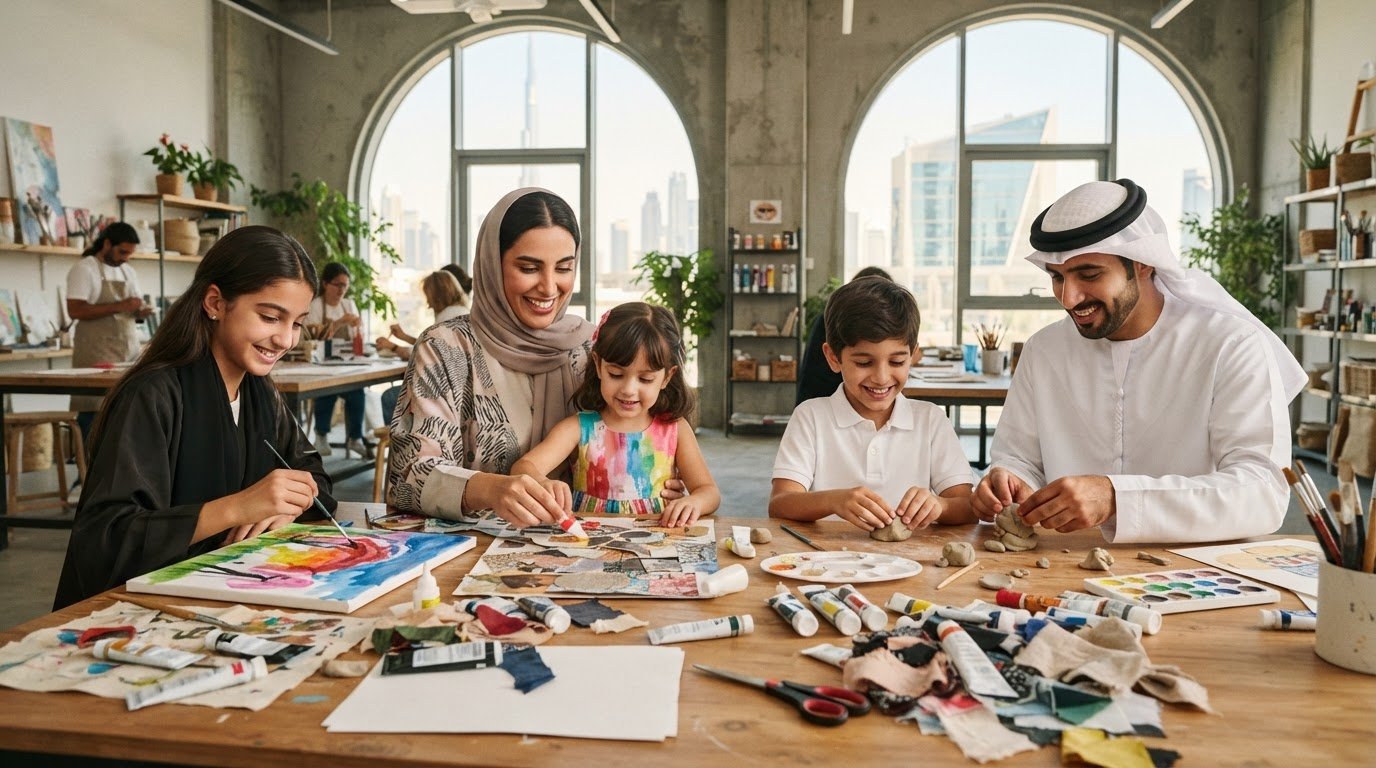
Creating a ritual around your practice transforms a simple hobby into a protected environment for your spirit. It's the scent of the heavy-body acrylics, the steady click of the knife against the palette, and the intentional cadence of your breathing. This sensory experience bridges the gap between your internal state and the external form. Art is a collaborative journey of self-discovery where the act of creation serves as a bridge to inner clarity. If you're ready to experience this stillness in person, our Palette Knife Painting Workshop provides a serene space on Sheikh Zayed Road to begin your journey.
Elevating Your Practice: From Home DIY to a Dubai Art Studio
While exploring palette knife techniques for beginners in your own home offers a wonderful starting point for self-discovery, there comes a moment when the limitations of solo practice can feel restrictive. Self-teaching often involves a series of trial and error that, while valuable, can sometimes lead to frustration when the paint doesn't behave as expected. Stepping into a professional studio shifts this experience from a solitary effort into a collaborative journey. In-person guidance allows you to receive immediate, tactile feedback on the subtle nuances of your grip and the specific angle of your blade, which are often the keys to unlocking more complex textures.
The energy of a shared, supportive environment provides a sense of psychological safety that is difficult to replicate alone. When you join a palette knife painting workshop, you aren't just learning a skill; you're joining a community of individuals who are all navigating their own creative flow. This collective stillness helps to lower defenses and encourages a deeper state of mindfulness, making the act of creation feel like a shared exhale. It's a space where your individual agency is celebrated, and the pressure of the outside world is left at the door.
The Value of Expert Guidance
In a professional setting, you gain access to high-quality professional mediums and specialized knives that might not be part of a standard home kit. Expert facilitators can demonstrate exactly how much pressure is needed to achieve a specific peak or how to layer without muddying the colors. This real-time interaction accelerates your learning curve, turning hours of guesswork into moments of clarity. It's about providing a protected environment where you feel empowered to experiment, knowing that guidance is always within reach. This foundation is essential when transitioning from basic strokes to more intricate 3D texture art.
Your Creative Journey in Dubai
Visiting our serene studio on Sheikh Zayed Road offers a physical sanctuary away from the city's bustling pace. A single session can act as a mental well-being reset for your entire week, providing a dedicated space for reflection and internal exploration. As you work through the layers of your piece, you're also working through your own internal states, translating them into external forms that you can touch and see. Taking your finished textured canvas home serves as more than just a decoration; it's a physical symbol of your personal growth and the courage you found to explore the depths of your own creative potential.
Embracing Your Journey of Textured Discovery
Stepping into the world of impasto is more than just learning a new art form; it's an invitation to quiet the mind and listen to the rhythm of your own heart. By mastering palette knife techniques for beginners, you trade the anxiety of perfection for the liberating joy of tactile expression. We've explored how simple tools and buttery textures can transform a blank canvas into a landscape of emotional clarity. You now understand that the "ugly stage" is merely a sign of growth, a necessary part of the dialogue between your inner self and the external form.
While self-discovery begins at home, true expansion often happens within a protected environment. We invite you to discover your creative sanctuary at our next Palette Knife Workshop in Dubai. Step into our serene studio on Sheikh Zayed Road, where all materials are provided so you can focus entirely on your curiosity. Our compassionate instructors are here to guide your creative flow, ensuring you leave with a piece you're proud of and a sense of deep peace. Your canvas is waiting, and the journey is yours to take.
Frequently Asked Questions
What kind of paint is best for palette knife techniques?
Heavy body acrylics or oils are the ideal choice because they possess the structural integrity required to hold peaks and ridges. Unlike fluid paints, these thick mediums allow you to explore palette knife techniques for beginners with satisfying physical resistance. In our Dubai studio, we focus on how these buttery textures can mirror your internal emotional states, providing a bridge between your creative intention and the physical form on the canvas.
Do I need to prime my canvas before using a palette knife?
Most modern canvases come pre-primed with gesso, which is essential for providing a stable foundation for thick applications. If you're working on raw wood or heavy paper, applying a layer of primer ensures the paint doesn't soak into the fibers, which can cause cracking over time. This preparation creates a protected environment for your artistic expression, allowing the blade to glide smoothly as you begin your collaborative journey of self-discovery and healing.
How do I stop my colors from getting muddy when mixing with a knife?
The most effective way to maintain color purity is to follow the "one-wipe" rule by cleaning your blade with a cloth between every single stroke. Muddy tones often occur when colors are over-blended on the canvas rather than mixed intentionally on the palette. By slowing down and practicing stillness between movements, you can keep your highlights crisp and vibrant, allowing each hue to represent a distinct part of your individual agency and creative vision.
Can I use a palette knife with watercolor or gouache?
Traditional watercolors are generally too fluid for these methods, but acryl-gouache or thick artist gouache can be used for subtle textures. These mediums lack the heavy body of acrylics or oils, so they won't hold high peaks, but they can still offer a gentle, rhythmic application. For those seeking the full sensory experience of impasto, we recommend heavier mediums that allow for the deep, internal exploration found in a dedicated 3D texture art workshop.
How long does a thick palette knife painting take to dry?
Drying times vary significantly based on the medium and the thickness of the layers. Heavy body acrylics typically feel dry to the touch within 24 hours in Dubai's climate, though deep impasto sections may take longer to cure fully. Oil paintings involve a much slower, more deliberate process, often requiring several weeks or even months to dry. This waiting period can be a beautiful exercise in reflection and patience as your work evolves.
Is palette knife painting easier than brush painting for beginners?
Many visitors find that palette knife techniques for beginners are far more liberating than traditional brushwork because they remove the pressure of precision. Without the "pointy brush" to worry about, you can focus on the sensory joy of the movement itself. This shift helps to quiet the inner critic and lower defenses, making it much easier to enter a state of flow and experience the stress-relieving benefits of the creative process.
How do I clean my palette knives after a session?
Cleaning your tools is a simple, rhythmic ritual that marks the completion of your session. For acrylics, a thorough wipe with a paper towel followed by a quick rinse in warm, soapy water is all that's required to keep the stainless steel blades pristine. If you're using oils, a small amount of solvent or oil on a cloth will remove any stubborn residue. Maintaining your tools is a way of honoring your creative sanctuary and preparing for your next journey.
What is the best palette knife shape for a total beginner?
A medium-sized diamond or teardrop-shaped blade with a cranked handle is the most versatile choice for those starting out. This specific shape allows you to explore broad "butter spread" strokes while using the pointed tip for delicate details or sgraffito lines. Having a tool with a bend in the handle is essential for keeping your hands clear of the wet paint, ensuring your experience remains a supportive and comfortable journey of discovery.

Comments