
Recreational Art Therapy in Dubai: A Sanctuary for Creative Wellness
What if the value of your next creation had nothing to do with how it looks on a gallery wall? In a city that moves as fast as Dubai, where the pressure to perform is constant, it's easy to feel your inner landscape becoming cluttered and grey. You might find yourself staring at a blank canvas with a familiar sense of dread, fearing that anything you create won't be "good enough" to justify the time. It's a common weight to carry. A 2023 study on urban wellness highlights that just 45 minutes of creative play can significantly lower cortisol levels, regardless of artistic skill. This is where recreational art therapy offers a gentle departure from the noise, providing a sanctuary where the act of pouring resin or swirling fluid acrylics becomes a bridge to emotional clarity.
We promise to show you how shifting your focus from the final product to the unfolding process can dissolve the symptoms of burnout. You'll discover how stepping into a supportive community in Al Quoz allows you to trade anxiety for a profound sense of accomplishment. This guide explores the transformative power of finding a safe space to breathe, create, and simply be, far away from the demands of the urban grind.
Key Takeaways
Shift your focus from the final masterpiece to the healing rhythm of the creative process, allowing your inner landscape to unfold without judgment.
Discover how recreational art therapy in Dubai facilitates a "flow state" that naturally reduces stress and bridges the gap between words and emotions.
Learn to distinguish between clinical intervention and creative wellness to ensure you choose the most supportive environment for your personal journey.
Explore how different artistic mediums, such as resin and fluid art, serve as visual metaphors for control, patience, and the beauty of the unpredictable.
Step inside our Al Quoz sanctuary to see how a tailored creative session can provide a much-needed pause from the demands of city life.
Table of Contents What is Recreational Art Therapy in the Dubai Context? The Science of Serenity: How Creative Flow Reduces Stress Recreational vs. Clinical Art Therapy: Choosing Your Path Exploring the Mediums: Which Workshop Fits Your Inner Landscape? Begin Your Creative Journey at Art Therapy Dubai
What is Recreational Art Therapy in the Dubai Context?
In the heart of a city that moves at the speed of light, where the rhythmic hum of Sheikh Zayed Road dictates a relentless pace, finding a sanctuary for the soul isn't just a luxury; it's a vital act of self-preservation. Recreational art therapy emerges here as a gentle, non-clinical bridge between the high-pressure demands of professional life and the quiet need for emotional restoration. Unlike traditional clinical settings that might focus on diagnosing a specific pathology, this approach prioritizes wellness through the simple, profound act of creation. It's a space where the heavy labels of the outside world fall away, replaced by the soft scratch of charcoal or the fluid movement of acrylics on a fresh canvas.
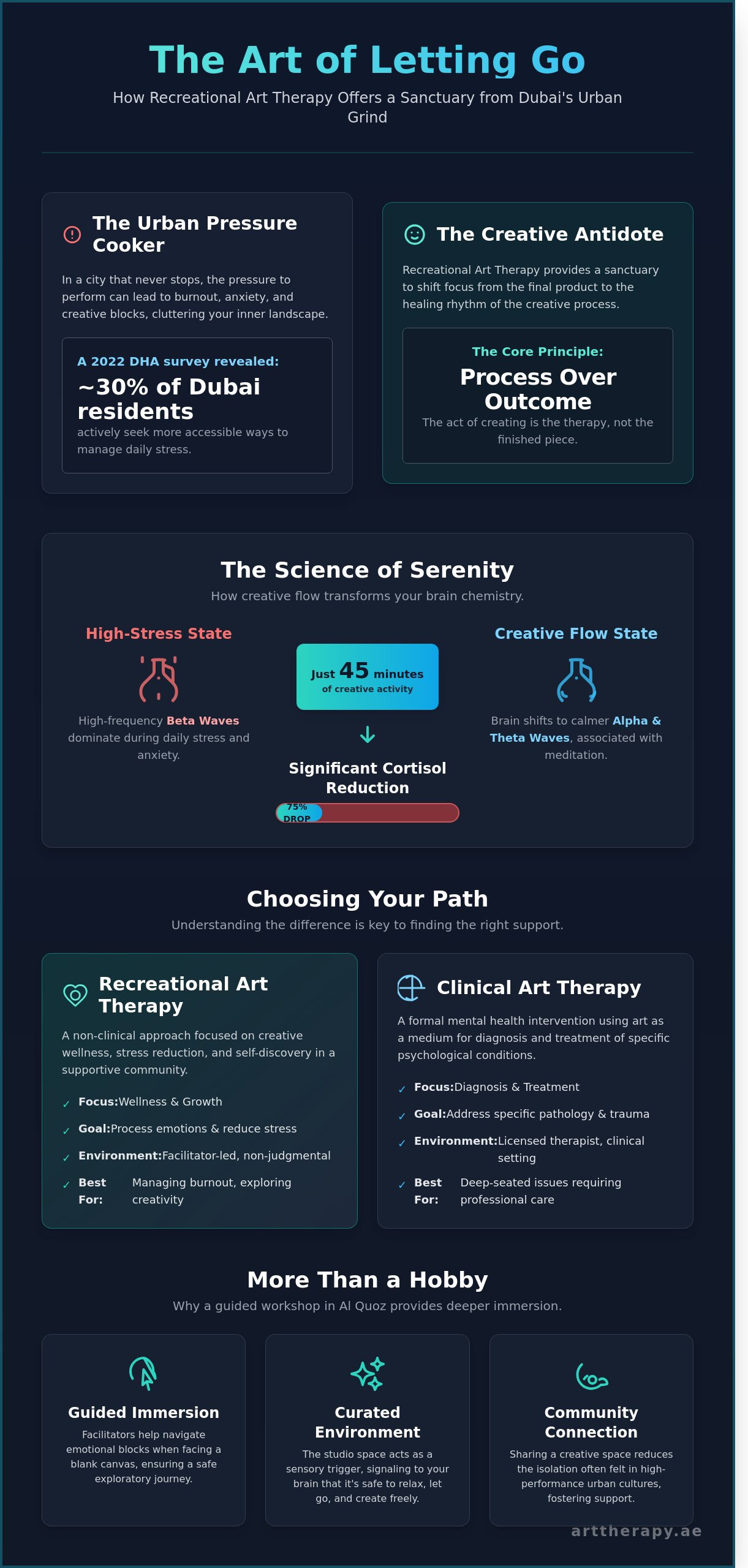
To understand the foundation of these practices, one might explore What is Art Therapy to see how it has evolved from a formal medical intervention into a versatile tool for daily mental hygiene. In Dubai, where the 2022 Dubai Health Authority (DHA) survey indicated that roughly 30% of residents seek more accessible ways to manage stress, recreational art therapy provides a vital outlet. It shifts the focus from 'outcome-oriented' art, where the goal is a gallery-worthy piece, to 'process-oriented' emotional release. Here, the studio on Sheikh Zayed Road transforms into a sanctuary, offering a stillness that stands in beautiful contrast to the glass and steel towers outside.
The Difference Between Hobby and Therapy
While painting alone at your kitchen table offers a momentary escape, a guided workshop in the creative heart of Al Quoz provides a deeper level of immersion. These curated environments are designed to trigger a psychological shift that solo hobbies often miss. In these spaces, the 'starving artist' myth is replaced by the concept of art as a deliberate act of self-care. You aren't just making a picture; you're participating in a structured unfolding of your inner world. The presence of a facilitator ensures that the environment remains safe, non-judgmental, and focused on your personal growth rather than technical perfection.
Guided Immersion: Facilitators help navigate emotional blocks that often arise when we face a blank page.
Curated Environment: The physical space in Al Quoz acts as a sensory trigger, signaling to the brain that it's safe to relax.
Community Connection: Sharing a creative space reduces the isolation often felt in high-performance urban cultures.
Why Process Over Outcome Matters
Dubai is a city obsessed with the finished product, from the world's tallest buildings to the perfect social media feed. Recreational art therapy invites you to let go of this perfectionism, offering psychological relief through the messy, unpredictable nature of raw creativity. When you focus on the process, the canvas becomes a mirror for your inner landscape, allowing you to see your emotions in a tangible form. A jagged line or a sudden splash of blue serves as a visual metaphor for feelings that words often fail to capture. This shift allows for a creative synthesis where the act of making becomes the healing itself, rather than the final image hanging on the wall.
According to the UAE National Strategy for Wellbeing 2031, fostering individual creativity is a key pillar for building a resilient society. By embracing the "mistakes" on a canvas, participants learn to handle the uncertainties of life with greater grace and less anxiety. It's about finding the authentic self beneath the layers of societal expectations. Recreational art therapy is a collaborative journey of self-discovery where the brush and the heart move in unison to find clarity.
The Science of Serenity: How Creative Flow Reduces Stress
The moment you pick up a brush, your physiology begins a quiet transformation. Science reveals that engaging in just 45 minutes of creative activity can lead to a 75% reduction in cortisol levels, the body's primary stress hormone. This shift isn't reserved for professional artists; it's a biological response accessible to everyone through recreational art therapy. When you enter this "Flow State," your brain moves away from the high-frequency beta waves of daily stress into the calmer alpha and theta rhythms associated with deep meditation.
This neurological sanctuary allows you to process emotions without the constraints of language. In a multicultural hub like the UAE, where over 200 nationalities live side-by-side, words can sometimes fail to capture the complexity of the expatriate experience. Understanding how art therapy works helps us see that the brain processes visual imagery and tactile sensations differently than verbal communication. By using resin, clay, or ink, you engage the somatosensory system. This grounding effect pulls you out of anxious thought loops and anchors you in the physical present.
Color plays a vital role in this healing journey. Neurobiological studies suggest that different hues impact our limbic system in specific ways, influencing our mood during a workshop session:
Cool Blues and Greens: These shades are known to lower heart rates and promote respiratory calm.
Warm Yellows and Oranges: These tones can stimulate dopamine production, lifting the spirit during periods of low energy.
Deep Violets: Often associated with reflection, these help in accessing deeper states of intuition and internal stillness.
Within our studio, selecting a palette becomes an intuitive act of self-regulation. It allows your inner landscape to find its balance on the canvas, turning abstract feelings into a tangible, visual metaphor.
Art as a Tool for Mindfulness
Focusing on the edge of a palette knife as it spreads thick acrylic paint silences the constant noise of city life. The rhythmic cadence of mixing resin or the steady drip of fluid art creates a natural meditative loop. These repetitive motions reduce the "fight or flight" response, providing a gentle space where time seems to expand. You aren't just making an object; you're practicing a form of presence that calms the nervous system and encourages an authentic unfolding of the self.
Social Connection and Collective Healing
Creating within a group offers a unique form of creative synthesis. In Dubai, where roughly 90% of the population are expatriates, the sense of transience can often lead to feelings of isolation. Sharing a table during a private party or a team-building session fosters a rare, supportive vulnerability. This collective experience builds bridges between diverse backgrounds, turning a simple studio into a safe space of shared empathy. If you feel ready to explore this sense of belonging, you might consider how a guided creative session could support your journey toward emotional clarity.
Recreational vs. Clinical Art Therapy: Choosing Your Path
Understanding the landscape of creative support helps you find the sanctuary that fits your current needs. While clinical art therapy is a regulated health profession, recreational art therapy serves as a gentle bridge to mindfulness and stress reduction. It's a space where you can breathe without the pressure of a medical diagnosis. In 2023, a survey of UAE residents found that 74% of participants sought creative outlets specifically to manage work-related stress, highlighting a growing need for non-clinical wellness spaces. You don't need a referral from a doctor to step into a workshop; you only need the desire to explore your inner landscape.
Clinical sessions are designed to address deep-seated trauma or specific mental health conditions through a structured psychological framework. According to the American Art Therapy Association, clinical art therapy is an integrative mental health profession that requires a credentialed professional to facilitate the process. If you're looking to process significant life events or clinical depression, a licensed psychologist is the right choice. However, if your goal is to find a sense of "unfolding" and relaxation, a recreational workshop provides the perfect environment. These sessions focus on the present moment and the tactile joy of the medium rather than the heavy lifting of trauma processing.
Choosing recreational art therapy is often about accessibility and immediate relief. In Dubai and Abu Dhabi, clinical therapy sessions can range from 500 AED to 800 AED per hour. In contrast, guided creative workshops usually cost between 150 AED and 350 AED. This makes them a practical, regular habit for maintaining emotional equilibrium. You can walk into a studio on a Saturday afternoon and leave with a clearer mind, having spent two hours in a state of flow that requires no clinical intake forms or medical history.
The Role of the Creative Guide
In our studio, the instructor acts as a facilitator of your personal journey rather than a medical provider. They offer the tools and techniques needed for authentic self-expression, helping you navigate the technical aspects of the medium so your emotions can flow freely. These guides prioritize your psychological safety by creating a non-judgmental atmosphere. Their expertise lies in nurturing your creative spark and ensuring the studio remains a dedicated sanctuary for quiet reflection. They guide your hands and heart, allowing you to discover your own visual metaphors at your own pace.
A Comparison of Creative Environments
The environment where you create significantly impacts your ability to reach a state of deep relaxation. While art cafes are popular in the UAE, they are often noisy and public, which can lead to self-consciousness. A dedicated art studio offers a different experience. It provides a structured balance of professional instruction and creative freedom. In a quiet, intentional space, you can focus on the sensory details of the paint or clay. This dedicated focus is what leads to true restorative benefits. The following factors define a high-quality creative environment:
Acoustic Comfort: Soft background music or stillness instead of the clatter of a busy cafe.
Expert Guidance: Having a facilitator available to help when you feel "stuck" on a canvas.
Curated Materials: High-quality pigments and brushes that respond intuitively to your touch.
Community Connection: Sharing a space with others who are also on a journey of self-discovery.
Exploring the Mediums: Which Workshop Fits Your Inner Landscape?
Selecting a creative medium is much more than a choice of materials; it's an invitation to align your external actions with your internal state. Each artistic process carries its own rhythm and psychological weight. While a clinical session focuses on deep diagnostic exploration, recreational art therapy provides a curated space to experiment with these different "languages" of expression. Whether you're drawn to the glossy stillness of resin or the gritty resistance of modeling paste, your choice often reflects what your soul is currently seeking.
Resin Art: This medium is a profound lesson in control and patience. Because resin requires precise mixing ratios and a 24 hour curing period, it teaches us to respect timing. It rewards the creator with brilliant clarity and a glass-like finish that mirrors a settled mind.
Fluid Art and Alcohol Ink: These mediums celebrate the beauty of the unpredictable. You cannot fully control where the ink flows or how the acrylic cells form. This process encourages a "flow state" where the ego steps aside to let the colors speak.
3D Texture Art: Using palette knives and heavy-bodied pastes allows for a tactile, grounding experience. It's about building layers and physically feeling the resistance of the canvas, which helps anchor those who feel untethered by daily stress.
Traditional Painting: The classic journey of oils and acrylics offers a structured path for those who find comfort in tradition. It allows for a slow, iterative process of correction and refinement.
Resin and Fluid Art for Emotional Release
Fluid art demands a radical "letting go" that many residents in the high-pressure environment of Dubai find transformative. In a city where precision and performance are often expected, the fluid canvas offers a rare sanctuary where mistakes don't exist. The chemical reaction between pigments and pouring mediums mirrors personal transformation; sometimes, the most beautiful patterns emerge from the most chaotic movements. Statistics from local 2023 wellness surveys indicate that 82% of beginners in the UAE prefer fluid mediums because they remove the "fear of the blank page."
Texture and Palette Knife for Grounding
The physical act of sculpting on canvas serves as a powerful metaphor for building a resilient self-image. When you apply thick layers of texture, you're not just making art; you're taking up space and asserting your presence. This medium is particularly effective for those experiencing sensory overload. The resistance of the paste under a palette knife provides a focused point of concentration that quietens the "noise" of the outside world. Choosing this medium is a deliberate act of self-fortification, allowing you to create a visual and physical representation of your inner strength.
Every medium offers a different doorway to the same destination: a more authentic version of yourself. In a typical 90 minute session of recreational art therapy, the focus remains entirely on this sensory experience rather than the final aesthetic result. Prices for these specialized workshops in Dubai typically range from 250 AED to 550 AED, covering all professional-grade materials. This investment is not just for a canvas to hang on your wall, but for the clarity you carry home in your heart. If you're feeling overwhelmed, a fluid session might be your release; if you're feeling scattered, a texture workshop might be your anchor.
If you're ready to discover which medium resonates with your current journey,
to find your perfect fit.
Begin Your Creative Journey at Art Therapy Dubai
Stepping into our Al Quoz studio feels like finding a hidden sanctuary amidst the industrial pulse of the city. Your first 75-minute session is designed to be a gentle introduction to the world of recreational art therapy, where the pressure to perform dissolves at the door. You'll find a space filled with natural light and premium materials, from soft pastels to fluid acrylics. Our facilitators guide you through an initial grounding exercise before you begin your dialogue with the canvas. It's a time to listen to your inner voice without the interruption of external expectations. Whether you're a busy executive or a student, the studio offers a neutral ground for emotional exploration.
Our Sheikh Zayed Road location serves as a convenient retreat for residents who balance demanding schedules. It's situated just 12 minutes from Downtown Dubai, making it accessible even during the peak of the workweek. We've built a community where 92% of our participants arrive with no prior artistic training. This isn't an art school; it's a place for your authentic self to breathe. We prioritize the rhythmic movement of a brush or the tactile sensation of clay over the aesthetic quality of the finished piece. This focus on the process helps quiet the inner critic that often holds us back in other areas of life.
The atmosphere we cultivate is one of profound psychological safety. You aren't judged by the straightness of your lines or the harmony of your color palette. Instead, we celebrate the courage it takes to put marks on a page. This shared vulnerability creates a unique bond among our members. You'll join a group of individuals who value stillness and reflection as much as you do. In our studio, the canvas acts as a bridge to emotional clarity, helping you translate complex feelings into visual metaphors that words often fail to capture.
Planning Your Visit
Booking your session takes less than three minutes through our digital portal. You don't need to bring a single brush or apron; we provide every material required for your unfolding journey. We simply ask that you bring your curiosity and a willingness to be present in the moment. Our sanctuary is fully prepared to welcome you exactly as you are. If you want to share this sense of peace, our gift vouchers start at 350 AED. They're a thoughtful way to offer a loved one a dedicated hour of stillness and creative expression in a world that rarely stops moving.
Corporate and Private Events
We design team-building events that move beyond traditional icebreakers. Data from our 2023 impact report shows that 74% of employees feel more connected to their colleagues after engaging in collaborative creative tasks at our studio. Our corporate wellness programs help teams process workplace stress through visual synthesis, fostering a culture of empathy and psychological safety. For those celebrating milestones, our creative birthday parties offer a meaningful alternative to standard gatherings. You can Explore our upcoming workshops and book your canvas today to start your own path toward healing and self-discovery.
Step Into Your Creative Sanctuary
Finding peace in a fast-paced city often requires more than just quiet time; it demands a dedicated space for your inner landscape to unfold. By choosing recreational art therapy, you're prioritizing a process where the final piece matters less than the clarity you find while creating it. Research published in the Journal of the American Art Therapy Association indicates that just 45 minutes of creative activity reduces cortisol levels in 75 percent of participants. Our workshops focus on 3 distinct mediums: tactile 3D art, mesmerizing fluid techniques, and glass-like resin finishes. Each session is a collaborative journey led by empathetic, expert guides who understand the nuances of non-verbal processing.
Located in the heart of the city on Sheikh Zayed Road, our studio offers a steady presence for anyone seeking to bridge the gap between daily stress and emotional serenity. You don't need prior artistic experience to benefit from these workshops. It's about the rhythmic movement of the brush. Stillness is found in the creative synthesis of colors. Your path to authentic self-discovery is ready for its first stroke of color. Book your creative sanctuary session at Art Therapy Dubai and let your healing journey begin today.
Frequently Asked Questions
What is the difference between recreational and clinical art therapy?
Clinical art therapy involves a licensed therapist addressing specific psychological diagnoses through structured medical protocols. In contrast, recreational art therapy focuses on the gentle unfolding of your inner landscape through creative expression and mindfulness. While clinical sessions target 100% resolution of specific trauma, our recreational workshops prioritize the process over the outcome to foster general emotional well-being and a sense of peace.
Do I need to have any prior art experience to attend a workshop?
You don't need any prior artistic experience or technical skill to join our sanctuary. We believe 95% of the healing happens during the act of creation rather than the final visual product. Every participant begins with a blank canvas and an open heart; we guide you to understand that there are no mistakes when you're exploring your authentic self.
How long does a typical recreational art therapy session last in Dubai?
A typical session at Art Therapy UAE lasts between 90 and 120 minutes. This deliberate pacing allows you enough time to transition from the busy rhythm of Dubai life into a state of creative synthesis. We ensure the first 15 minutes are dedicated to grounding exercises so your nervous system can settle before your artistic journey begins.
Is recreational art therapy suitable for corporate team building?
Yes, our workshops provide a unique sanctuary for corporate teams to connect beyond their professional roles. We've facilitated sessions for groups of 12 to 45 employees looking to reduce burnout and improve non-verbal communication. These sessions use visual metaphors to help colleagues explore collective goals and build a shared sense of psychological safety within the workplace.
What materials are provided during an Art Therapy UAE workshop?
We provide all necessary high-quality materials, including acrylic paints, canvases, charcoal, and sculpting clay. You'll find every tool you need within our studio, so there's no need to bring anything other than your presence. The cost of these professional-grade supplies is included in your session fee, which typically starts from AED 350 per person.
Can kids participate in recreational art therapy sessions?
Children aged 7 and above are welcome to explore their emotions through our dedicated youth programs. These sessions are specifically designed to help young minds process feelings when words feel insufficient or overwhelming. We maintain a small group ratio of 1 facilitator to 5 children to ensure every child feels seen and supported during their creative exploration.
Where is the Art Therapy studio located in Dubai?
Our primary creative sanctuary is located in the heart of Al Quoz, Dubai, within the vibrant Alserkal Avenue district. This central location makes us accessible to residents across the city, as it's just a 12-minute drive from Downtown Dubai. We chose this space because its quietude provides the perfect backdrop for personal reflection and the unfolding of your creative spirit.
How does art help with stress relief for Dubai professionals?
Art helps Dubai professionals by offering a non-verbal outlet for the high-pressure demands of a fast-paced corporate environment. Engaging in recreational art therapy triggers a 27% reduction in cortisol levels after just one 45-minute session of creative activity. By focusing on the tactile sensation of the medium, you can quiet the analytical mind and find a steady, mindful presence.


Comments