
How to Display Resin Art at Home, From Walls to Shelves
Your resin artwork doesn’t need a wall to make a statement. A display stand can hold a piece upright on a shelf or windowsill, making it easy to enjoy and move when you want a change. Knowing how to display your resin art at home also means choosing secure support for heavier pieces instead of relying on ordinary picture wire.
You want your art to feel at home without worrying about whether it’s properly supported. This guide explains how to choose a stand, arrange resin art on shelves and windowsills, display free-standing pieces, and hang heavier work with suitable hardware. Use these practical tips to find a secure, considered arrangement that works in your Dubai home.
Table of Contents
1. Hanging heavy resin art on a wall
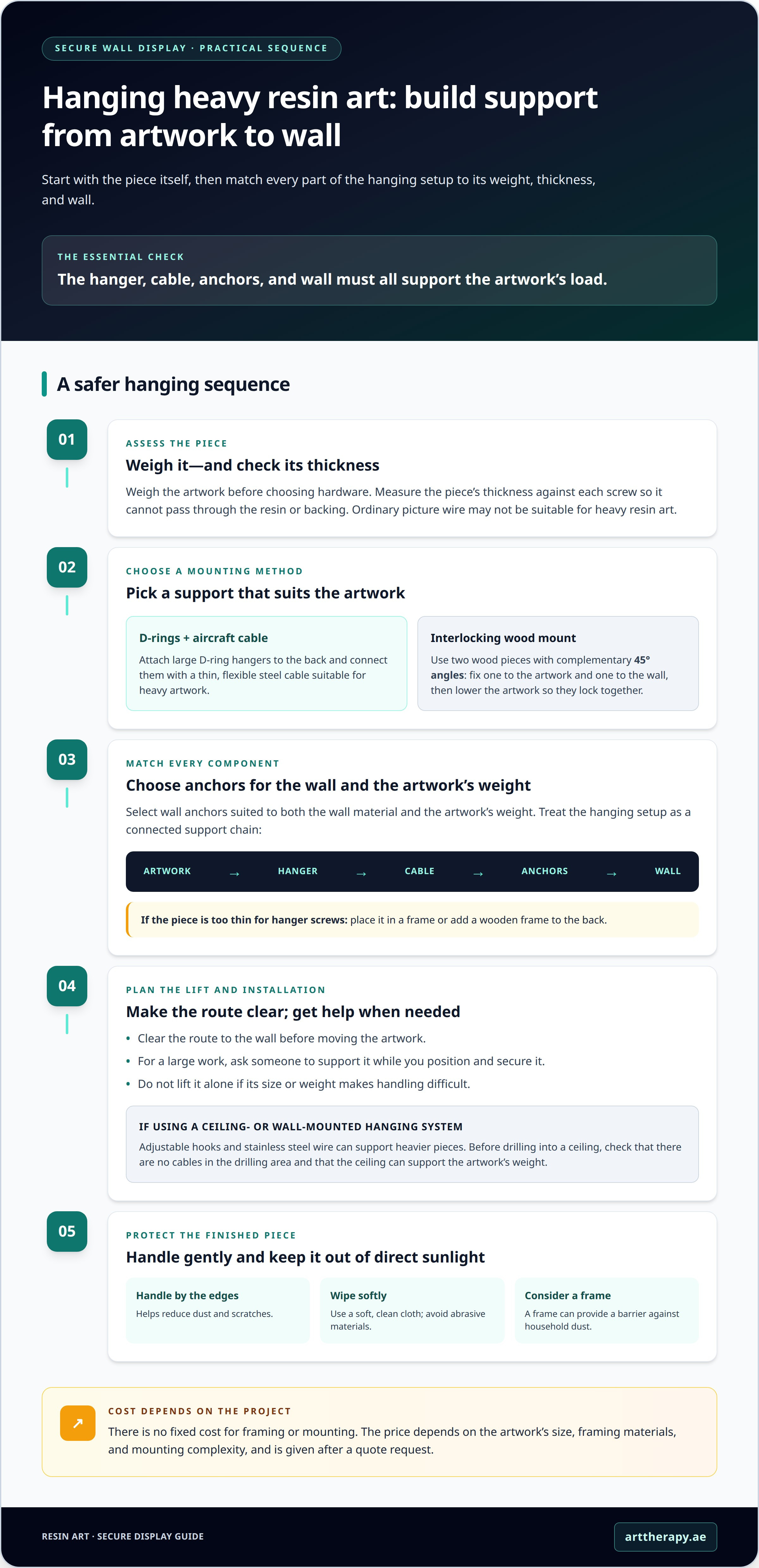
The cost to frame or mount resin art depends on the piece and its installation. The price depends on the case and is given after a quote request; size, framing materials, and mounting complexity affect the work involved.
For secure wall hanging, weigh the artwork first and choose hardware designed to support it. Ordinary picture wire may not be suitable for heavy resin art. Before attaching a hanger, measure each screw against the artwork’s thickness so it won’t pass through the resin or backing.
Attach large D-ring hangers to the back, then connect them with aircraft cable, a thin, flexible steel cable suitable for heavy artwork.
For a strong interlocking mount, use two wood pieces with complementary 45-degree angles. Fix one to the artwork and the other to the wall, then lower the artwork so they lock together.
Select wall anchors that suit the wall material and the artwork’s weight. The hanger, cable, anchors, and wall must all support the load.
If the resin piece is too thin for hanger screws, place it in a frame or add a wooden frame to the back. For a large work, ask someone to support the artwork while you position and secure it. Clear the route to the wall, and don’t lift a piece alone if its size or weight makes handling difficult.
To reduce dust and scratches, handle the artwork by its edges and gently wipe it with a soft, clean cloth. Avoid abrasive materials. Keep the piece out of direct sunlight, and choose a frame if you want a barrier against household dust.
A ceiling- or wall-mounted picture-hanging system with adjustable hooks and stainless steel wire can support heavier pieces. Before drilling into a ceiling, make sure there are no cables in the drilling area and that the ceiling can support the artwork’s weight.
There’s no fixed cost for framing or mounting; it depends on the artwork’s size, framing materials, and mounting complexity.
2. Choosing a display stand
A stand holds resin art upright without wall hardware. Plastic and acrylic display stands come in different sizes and styles, including clear and coloured options. Choose one that suits the artwork’s shape and the surface it will sit on, such as a narrow shelf or broad console.
Look at the piece from the side. Note its thickness, where its weight sits, and how much of its lower edge can rest securely on a stand. A stand that supports only a small part of the artwork may feel unstable, even if it looks attractive. Match the stand to the piece rather than choosing by colour alone.
Clear acrylic keeps attention on the artwork’s colours and layered details. A coloured plastic stand can create contrast or echo a shade in the resin. For example, a clear stand can sit quietly beneath a bright abstract panel, while a coloured option can complement a more restrained piece.
Before choosing a stand, place it on the intended surface and check that its base sits flat. Set the artwork in place and see whether it rests securely or shifts with a light touch. Test the arrangement on the actual shelf or windowsill: a stand that fits a table may be too wide for a narrow ledge. Keep the piece away from the edge, where a small bump could dislodge it.
Think about moving and cleaning, too. A lightweight stand can make it easier to reposition artwork as a room changes, while a simpler shape may be easier to dust around. If choosing a display stand inspires you to create a piece of your own, explore the Resin Art Workshop as a way to work with resin artistically.
3. Displaying artwork on a shelf or windowsill
A display stand lets resin art sit upright on a shelf or windowsill without wall fittings. It’s also easy to move when you rearrange a room or clean the surface. Set the stand on a level part of the ledge, then position the artwork so its weight rests securely against the support. A narrow shelf may suit a compact piece better than a broad panel.
Choose a spot where the artwork can be seen clearly, rather than hidden behind books or plants. Place a small resin panel at eye level beside a reading chair, for example, or set a wider piece on a low console. Check the view from where you usually sit and stand, then adjust the shelf position or artwork orientation until its details are visible from both.
On a windowsill, leave room around the stand and keep the piece clear of curtains, blinds, and anything that could knock it over. A stand makes it easy to move the artwork when opening a window or cleaning the sill. Resin-preserved flowers can also stand upright on a shelf or be placed inside a display case.
There’s no single display rule for every Dubai home. If you rent, review your tenancy terms before drilling to hang artwork; a shelf or windowsill avoids making holes in the wall. Choose a spot based on the piece’s size, viewing angle, and how people move through the room.
On a narrow ledge, use a stand that fits fully on the surface.
On a bookshelf, leave a clear view of the artwork’s edges and details.
On a windowsill, keep the stand away from curtains and frequently handled objects.
Check the arrangement in daylight and in the evening. Layered colours may look different as the room’s light changes, so turn the piece slightly to find the most appealing angle. Once you’re happy with its position, leave enough space around it to avoid crowding the artwork.
4. Displaying free-standing resin art
Free-standing resin art can become part of a room’s everyday rhythm instead of sitting only on a wall. Choose a flat, stable surface that suits the piece, such as a console, side table, or entryway shelf. A resin tray near the entryway can hold keys and sunglasses while giving the artwork a practical role.
Keep the tray on a surface where it won’t be pushed or crowded by everyday items. Leave enough room to place keys without knocking the resin piece, and avoid a spot beside a doorway where bags or coats may brush against it. For a sculptural piece, turn it slowly on the surface and choose the angle that shows its form from the room’s main viewing point.
Lighting can bring out colour and depth, but a direct beam may reflect sharply off a glossy resin surface. Use soft, indirect room lighting, or place a lamp to the side rather than aiming it straight at the artwork. Step back and adjust the lamp until you can see the details without a bright reflection obscuring the piece.
Keep resin art away from direct sunlight and heat sources such as heaters. Choose a shaded spot with a comfortable viewing angle, then check how natural light reaches it throughout the day. A place that’s shaded in the morning may get direct sun later, so observe the light’s path before settling on a permanent position.
For a considered arrangement, group a free-standing piece with just a few nearby objects. A resin tray, a small bowl, and some clear tabletop can create a useful entryway display without hiding the artwork. Keep drinks and other items that might spill away from the resin surface. Dust around the piece with a soft cloth, and lift it carefully before cleaning underneath.
Make your display both expressive and useful. A tray can gather everyday essentials, while a sculptural piece can create a quiet focal point on a side table or console. If you are styling an entire living space, pairing your custom resin work with complementary furniture and decor from Attica House can help pull the aesthetic together seamlessly.
Art Therapy: Resin Art Workshop
Art Therapy’s Resin Art Workshop is a natural next step if you’d like to create a piece and decide how it might live in your home. The workshop offers space to explore resin art through the making process, from choosing an approach to seeing how colours and forms come together. As you create, you can imagine whether your finished work might suit a wall, a stand, or a shelf. That connection between making and displaying can help you shape a piece with its future setting in mind.
If you’re drawn to a different surface or style, Acrylic Painting, Oil Painting, and 3D Texture Art workshops offer other creative directions. Each begins with the experience of making, leaving room for your own ideas to take shape.
Contact Art Therapy to learn more about the Resin Art Workshop.
Make room for your next creative idea
Deciding how to display your resin art at home can help you notice what you enjoy creating: colour, texture, shape, or the way light moves across a surface. Let that observation guide your next piece. Sketch an idea inspired by a corner of your room, then imagine how its form could sit in that space.
Art Therapy offers Resin Art, Acrylic Painting, and Oil Painting Workshops for people without drawing experience. Each gives you a different way to experiment with materials and bring a personal idea to life. Your finished work doesn’t need to match a particular style or room; it can grow from curiosity, one creative choice at a time.
Contact Art Therapy to explore your next art-making idea, and take a gentle first step toward creating something that feels at home with you.
Frequently Asked Questions
How can I display my resin art upright on a shelf, or windowsill?
Use a display stand that fits the artwork and sits fully on the shelf or sill. A small resin panel can sit beside books, while resin-preserved flowers can stand alone or go in a display case. As you consider how to display your resin art at home, leave open space around the piece so its shape stays visible and it won’t be bumped during everyday use.
How can I hang heavy resin art pieces?
Choose a mounting method that secures the artwork without putting pressure on its resin surface. A wooden French-cleat-style mount uses two pieces with matching 45-degree angles, allowing them to lock together when hung. Another option is attaching large D-rings and aircraft cable, with screws sized so they won’t pass through the artwork. The wall anchors must also support the piece’s weight.
How can I hang my artwork from a ceiling or windowsill?
For lightweight resin artwork, a ceiling hook and picture wire can suspend it from above. Before drilling into a ceiling, make sure there are no cables in the drilling area and that the ceiling can support the artwork. Treat a windowsill as a surface: place the piece upright on a stand rather than suspending it from the sill.
What are the best ways to display resin art at home?
The best way to display your resin art at home depends on the piece’s size and the space available. Use a wall mount for suitable wall art, a stand for upright display, or a flat surface for free-standing pieces such as resin trays. Resin-preserved flowers can sit on a shelf or in a display case. Keep each piece visible and securely positioned.
How do you display resin art on shelves or easels?
On a shelf, set the artwork on a stand that supports it upright and fits within the shelf’s depth. If you use an easel, choose one that holds the piece securely and place it on a stable surface. Check that the artwork doesn’t shift when gently touched, and leave room to lift it when cleaning the shelf or changing the display.



Comments